Ordrupgaard Sample 1
Institution: Ordrupgaard
Exhibition: Drømmenes Port. Symbolisme
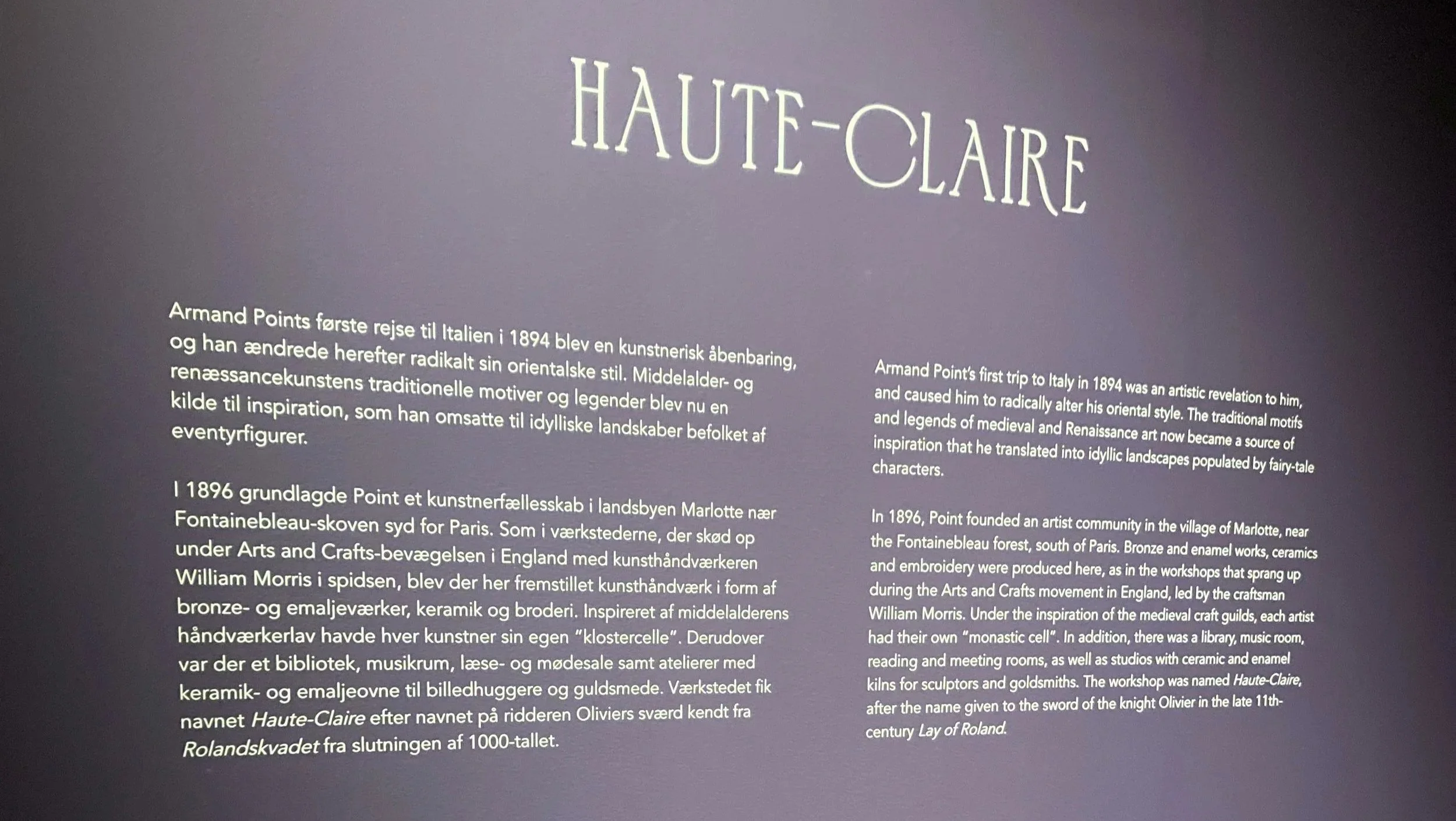
Wall text for the Haute-Claire section of the exhibition
As written:
Armand Point’s first trip to Italy in 1894 was an artistic revelation to him, and caused him to radically alter his oriental style. The traditional motifs and legends of medieval and Renaissance art now became a source of inspiration that he translated into idyllic landscapes populated by fairy-tale characters.
In 1896, Point founded an artist community in the village of Marlotte, near the Fontainebleau forest, south of Paris. Bronze and enamel works, ceramics, and embroidery were produced here, as in the workshops that sprang up during the Arts and Crafts movement in England, led by the craftsman William Morris. Under the inspiration of the medieval craft guilds, each artist had their own “monastic cell.” In addition, there was a music room, reading and meeting rooms, as well as studios with ceramic and enamel kilns for sculptors and goldsmiths. The workshop was named Haute-Claire, after the name given to the sword of the knight Olivier in the late 11th-centry Lay of Roland.
Better:
Armand Point’s first trip to Italy in 1894 was an artistic revelation for him, after which he radically altered his Orientalist style. The traditional motifs and legends of medieval and Renaissance art now became a source of inspiration, which he transformed into idyllic landscapes populated by figures from English legend and fantasy.
In 1896, Point founded an artist colony in the village of Marlotte, near the Fontainebleau forest south of Paris. Like in the workshops of England’s Arts and Crafts movement, which was led by craftsman William Morris, bronze and enamel works, ceramics, and embroidery were produced here. Inspired by the medieval craft guilds, the colony offered each artist their own “monastic cell.” There were also rooms dedicated to music, reading, and meeting; as well as studios with ceramic and enamel kilns for sculptors and goldsmiths. The workshop was named Haute-Claire, after the sword given to the knight Oliver in the late 11th-centry French epic the Song of Roland.
Why is this better?
As written, the English text indicates that the trip to Italy was necessarily the reason for him altering his style. The Danish text implies this, but doesn’t indicate it directly.
Fairy-tales, in English, are children’s stories. This is not necessarily the meaning implied by eventyrfigurer in the Danish text. Figures from legend and fantasy is a more accurate translation.
There is no need for a comma after Fontainebleau forest.
The way the sentence about the workshops is arranged, it leaves open the possiblity that Point’s workshops were led by William Morris. The arrangement of the Danish text is better in English, as well, for the sake of clarity.
Also, in English, the word order of the next sentence implies that the artists were inspired by medieval craft guilds, not the colony. This word order makes the meaning more clear.
In English, the knight is usually called Oliver, not Olivier, and the epic is far more widely known as the Song of Roland, not the Lay of Roland.